
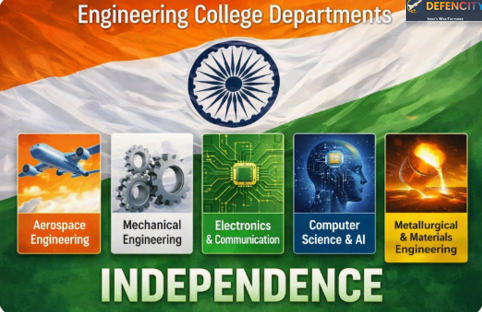
🧩 Why Departments [of Engineering Colleges] Should be Made Independent
This 80th Independence Day, as India starts making progress and strives to be the third largest economy, Engineering Education has to play its part. This will ensure a push effect in this dream of being the third largest economy.
India just crossed a threshold most of us weren’t watching closely enough. We’re now fabricating semiconductor chips domestically. We’re launching spacecraft on our own timelines. Industry and government are moving on AI at a pace that would have sounded implausible a decade ago. This 80th Independence Day, the question worth asking isn’t whether India can keep up with this shift — it’s whether our engineering institutions can.
The numbers say we should be worried. India has roughly 6,000 to 6,200 engineering and technology institutions, producing about 1.5 million graduates every year — one of the largest engineering pipelines on earth. And yet, by most honest accounts, only 40–45% of these graduates are considered technically employable, and reports like the Unstop Talent Report suggest up to 83% walk out with zero immediate job or internship offers through campus placements.
This isn’t a talent shortage. It’s a relevance shortage. Engineering Education is at a crisis.
Something has been seeping into engineering education for years, quietly — not overnight, not through any single scandal, but through a slow accumulation of non-merit decisions: in hiring, in promotion, in who ends up standing in front of a classroom.
Some of that non-merit has now settled into faculty positions themselves, teaching the next generation. This is no longer a performance problem. It’s closer to a survival crisis — a moment where the relevance of engineering education, as an institution, is genuinely being tested.
There is no shortage of proposed fixes for Indian engineering education — new curricula, new accreditation frameworks, new rankings. Most of them treat the college as the unit that needs fixing.
I argue for something narrower, and because it’s narrower, more achievable: a single structural change, aimed not at the college, but at the department within it.
Focus on the Departments.
Specialization ✅
Departments Specialize – Not Colleges. Lets look at this objectively.
Departments want to grow. Infact, the College managements know that it is Departments which should be the focus. But, most shy away from this. How many times have we heard IIT Bombay – Electronics is very good. NIE Mech was good in my time. So, we get the message. We should allow Departements to grow independently.
Industry Alignment✅
Departments can showcase niche capabilities (e.g., CAD/CAM labs, UAV research groups) that directly match market requirements.
Talent Mapping ✅
Recruiters and startups want to know which department produces the right skill sets — not just the overall college ranking. When Departments independently interact with recruiters they can base their decisions in the interests of the Department Students. The sum of Department Rankings should be embedded into NIRF Rank.
Visibility for Collaboration ✅
Departments which are dynamic and progressive can independently partner with MSMEs and OEMs for R&D projects, internships, and for joint patents, to suit their infrastructure to create high visibility.
Keep up with Technology✅
Departments can keep up with Technological changes if left to chart an independent path. This is simply because AI for Electronics means something else entirely for Mechanical. Brings in focus and diversity which inturn benefits the Eng. Institution.
Challenges Colleges Will Face
Loss of Central Control ⚠️
College managements fear that departmental independence means losing grip on brand, compliance, and quality consistency. NBA/NAAC accreditation and NIRF submission still happen at the institution level — devolving too much too fast creates a compliance and reporting nightmare.
Overcome: Separate administrative/financial autonomy from external-facing autonomy. Let departments own their industry partnerships, R&D visibility, and recruiter relationships — while accreditation, compliance, and core admissions stay centralized. Departments don’t need full financial independence to be independently discoverable.
Uneven Department Strength ⚠️
Every college has 2-3 strong departments and several average ones. Independence spotlights the gap — strong departments get more visible, weaker ones get more exposed, which is exactly what risk-averse managements want to avoid.
Overcome: Frame this as a feature, not a risk — a transparent, objective department-level scorecard (patents, industry MOUs, placement quality by domain, R&D output) gives every department a growth path instead of hiding behind an aggregate college rank. Weak departments get a clear signal of where to invest, rather than being permanently masked by strong ones.
Internal Politics and Power Struggles ⚠️
A strong, independently visible department head can become a rival power center to the Principal/Director — colleges are wary of empowering department-level fiefdoms.
Overcome: Independence should be framed around external visibility and industry partnership rights, not internal governance authority. The department head’s autonomy extends to how they engage MSMEs/OEMs and showcase capability — not to overriding institutional hierarchy.
Lack of Industry-Liaison Capacity ⚠️
Faculty are trained to teach and research, not to run partnerships, negotiate MOUs, or manage a department’s external brand. Genuine independence requires business-development skills most departments don’t have.
Overcome: A centrally funded, department-embedded industry-liaison role — one person per department (or shared across a few) whose job is external visibility and partnership-building, reporting into the department but resourced by the college.
IP and Patent Ownership Ambiguity ⚠️
Joint patents and R&D projects with MSMEs raise the question of whether IP sits with the department, the institution, or the industry partner — unresolved, this becomes a legal blocker to every collaboration.
Overcome: A standard IP-sharing framework set centrally, before departmental autonomy is granted — so individual departments aren’t negotiating first-of-its-kind terms every time they partner.
Independence for our Engineering College Departments
None of this requires dismantling the college, or the Trust, or the systems of accreditation and compliance that legitimately need to sit at the institutional level. It requires something much narrower and much more achievable: letting the department — the actual unit of specialization, the actual unit recruiters and industry care about — step into the light on its own terms.
A department that can showcase its capabilities, choose its own industry partners, and be measured on what it actually produces isn’t a threat to the college it belongs to. It’s the thing that makes that college worth attending in the first place.
This 80th Independence Day, the most useful thing Indian engineering education could declare independence from isn’t its colleges, its rankings, or even its accreditation bodies. It’s the idea that a department’s worth can only be seen through the blur of an institutional average. Let the department that built the UAV lab be known for the UAV lab. Let the one holding the CAD/CAM partnership be known for it. The chip fabs and the spacecraft launches didn’t wait for a whole ecosystem to move together — they were built by teams narrow enough to specialize and visible enough to be trusted with the work. Engineering education deserves the same chance.
HOD Empowerment ✅
Grant HODs real autonomy — but scoped precisely: authority over industry partnerships, R&D direction, and how the department showcases its own capability. Not admissions, not cross-department budget, not the institutional compliance that rightly stays with the Trust and Director. This is domain authority, not governance authority — power to build the department’s external identity, not to rival the institution’s internal one.
Keep HOD salaries on par with the Director’s. Not as a courtesy, but as a signal: specialization is being valued as highly as administration. This alone changes what a compensation package tells a talented professor about where their future lies.
And make becoming an HOD the pinnacle of a professor’s career — not a detour from it. Today, the strongest academics are pulled away from their department and toward Principal or Director-track administration, trading depth for breadth. Reverse that incentive, and the person best qualified to lead a department’s specialization is the person who actually stays to do it.
This is the single step this piece is advocating.
Not a new layer of bureaucracy, not another accreditation framework — just power, status, and career incentive, finally pointed at the people already closest to the work.